Esquiline Hill
Quo VadisEsquiline Hill is one of the districts caught in the widening Great Fire of Rome, and a focal point in the novel’s account of how the catastrophe overwhelms the city. As flames advance toward the hill, authorities order buildings demolished to create breaks in their path; the measure saves part of the district, while the surrounding fire, shortages, and displacement turn the urban landscape into a crisis of survival and public authority.
Setting and Place in the Fire
The fire’s advance is described as a movement across Rome’s high ground and densely built valleys. After beginning near the Circus Maximus, the conflagration spreads into the city’s central districts; as the wind changes, it carries flames, brands, and cinders toward the Caelian, Esquiline, and Viminal. Esquiline Hill is thus not an isolated setting but one of several districts exposed to the fire’s shifting course.
The danger arises from the close-packed fabric of the city. Valleys contain streets lined with houses five or six stories high, shops, booths, temporary wooden amphitheatres, and storehouses holding combustible goods, including wood, olives, grain, nuts, pine cones, and clothing. When flames reach these materials, they spread with extraordinary speed. The narrative also describes new fires breaking out away from the principal blaze and presents the suspicion of deliberate fire-setting as a conclusion people draw from that pattern, not as independently established proof of responsibility.
Demolition and the Attempt to Contain the Flames
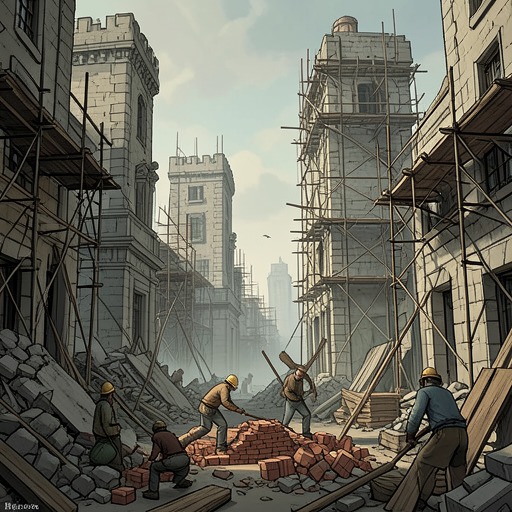
On Tigellinus’s orders, houses on Esquiline Hill are torn down so that the fire will encounter open space and die out. The demolitions are part of a wider emergency response: soldiers and some inhabitants also pull down buildings on the Caelian and in the Trans-Tiber district. These clearances help preserve considerable portions of those areas, including parts of the Esquiline, even as the city’s center remains beyond saving.
The action reveals the painful limits of urban rescue. Demolition can interrupt the spread of fire, but it requires the destruction of homes and cannot restore what the flames have already consumed. Nor does the account portray the measure as free from mistrust: some people suspect that soldiers are clearing buildings not to halt the fire but to prevent any part of the city from surviving. The difference between the authorities’ stated emergency purpose and the public’s suspicion becomes part of the larger breakdown in confidence.
Refuge, Hunger, and Disorder
The fires and demolitions unfold amid the mass displacement of Rome’s population. People flee through the gates and establish temporary camps beyond the walls; the countryside toward the Alban Hills becomes a vast sprawl of tents, huts, vehicles, bundles, and cooking fires. Families and individuals who have escaped the flames still face the loss of their homes and possessions, while the city’s destruction also removes the provisions stored within it.
Hunger follows quickly. The crowds outside the walls begin to feel the shortage on the second day, before adequate replacement supplies have been organized. Once orders are sent to Ostia, bread and flour are brought from there and from nearby towns and villages. At the Emporium, however, the first arriving supplies are seized by a crowd that breaks through the gate; the ensuing struggle scatters flour across the area, and soldiers eventually retake the building and disperse the people. The episode shows how the fire’s destruction of urban stores becomes a supply crisis, and how relief efforts themselves can become flashpoints when need outruns orderly distribution.
From Urban Disaster to Political Crisis
The fire remakes Rome’s geography into a scene of mass encampment and uncertain rule. The account contrasts the catastrophe with the Gallic invasion under Brennus: now even the Capitoline Hill is surrounded by flames, and the displaced population is described as a many-tongued crowd that includes citizens, slaves, freedpeople, merchants, soldiers, and others. Rumors travel among them—of future relief, poisoned aqueducts, or Nero’s intention to destroy the city—and produce alternating hope, fear, and anger.
Esquiline Hill’s partial survival cannot offset the broader destruction. Priceless artworks, temples, and monuments accumulated over centuries are lost, and hundreds of thousands are left without shelter. In this setting, the attempt to contain the fire by clearing buildings is at once a practical intervention and a visible sign of catastrophe: the city can still take emergency action, but neither its infrastructure nor its authority can prevent the disaster from becoming a humanitarian and political emergency. The district’s role in the narrative therefore joins the physical mechanics of the fire to its consequences—displacement, scarcity, public suspicion, and the fragile effort to keep order.